Parish: FRISTON
District Council: EAST SUFFOLK (previously Suffolk Coastal)
TM 405 603
Not open to the public
The village of Friston is situated on rising ground overlooking the River Alde to the south, c. 6.5km (4mls) from the seaside town of Aldeburgh to the east. Friston Hall (Grade II), stands to the west of the village in a remote position surrounded by arable land.
The manor of Friston was the property of Snape Priory until Cardinal Wolsey acquired it in 1524. In 1532 it passed to Michael Hare (or Hall) who built the original house. It was sold to Sir James Bacon, son of Robert Bacon of Drinkstone, Suffolk and stayed in the Bacon family, being owned by Thomas Bacon, barrister and MP for Suffolk and Aldeburgh when the substantial house had twenty hearths in 1674. Thomas was succeeded by his son Nathaniel Bacon (1647–76). The Friston Hall Estate was sold to Sir Henry Johnson (c. 1659–1719) c. 1682, who is believed to have rebuilt the Hall. It passed to his son, also Sir Henry Johnson, an eminent shipbuilder and politician, whose second wife was the Hon. Martha Lovelace. In 1681 the large and important house is documented as having dove-houses, gardens, orchards, stables, decoy pool and warren.
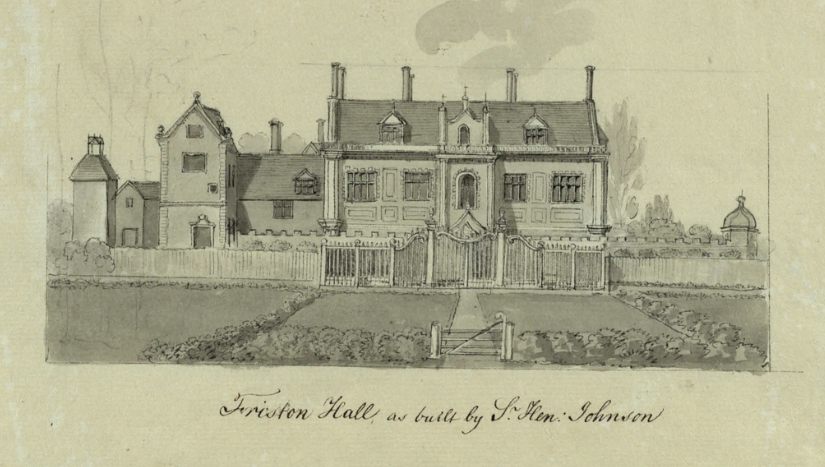
Later repairs to windows at the Hall and Decoy House were made. An undated drawing in the Isaac Johnson Map Collection at Suffolk Archives, probably late-seventeenth or early-eighteenth century, shows the house of Sir Henry Johnson that was built c. 1682. The Hall and gardens are shown within an enclosure of wooden fencing interrupted by ornate wrought iron fencing and gates in front of the main range of the house. Forming an inner enclosure immediately in front of the house was an arcaded and crenelated wall that extended to the east to an octagonal building with domed roof, probably a summerhouse.
Martha succeeded her grandmother as Baroness Wentworth in 1697 and inherited estates in Buckinghamshire and Bedfordshire that became their main residences. Sir Henry was succeeded by his daughter Anne (d. 1754) who married Thomas Wentworth, First Earl of Strafford (d. 1739) of Wentworth Castle in Yorkshire. The Earls of Strafford held the estate throughout the eighteenth century and made substantial alterations and additions to the house. On the death of the Third Earl in 1799 it was inherited by his cousin Richard William Howard Vyse of Stoke Place, Slough, Buckinghamshire.
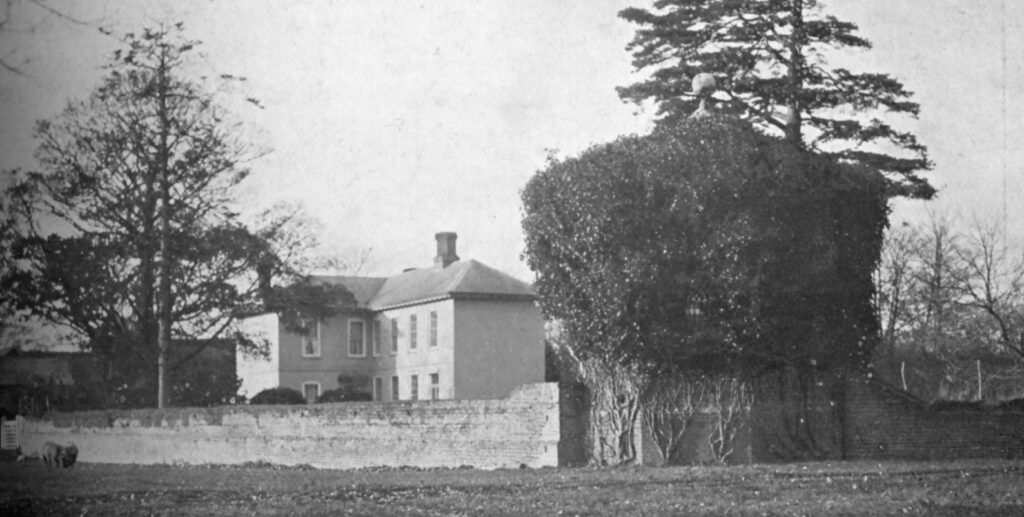
Much of the house was demolished during the early-nineteenth century and the remainder leased out as a farmhouse with parts of the estate consisting of heath, woodland, duck decoy and creeks next to the River Alde sold to become the Black Heath Estate. Friston was acquired by Thomas Frederick Charles Vernon-Wentworth of Wentworth Castle c. 1900. He also owned the Black Heath Estate, thus reuniting the land previously sold, although in 1990s Blackheath was sold once again. Into the twenty-first century a Wentworth family member owns and farms the land from the house, now called Friston Hall Farm, although modern farming methods mean that the farm buildings had become obsolete and have been converted for office and other uses.
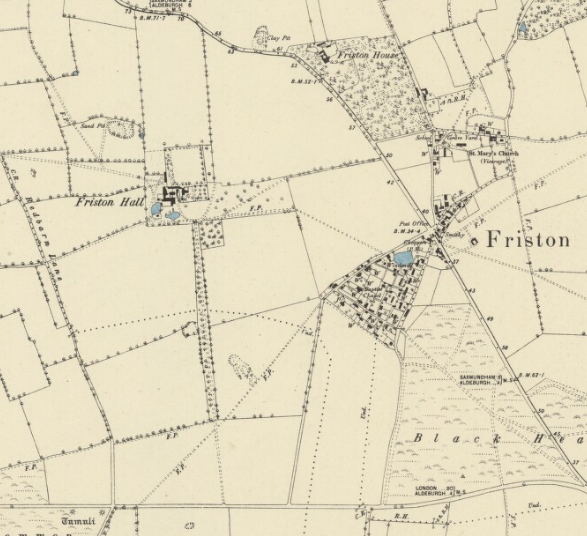
Depicted on maps throughout the eighteenth century, although likely to have been much older, an avenue ran south for c. 1.6km (1ml) from the house to Snape Warren that was crossed by the road running west to east to Aldeburgh, the northern section forming the entrance drive for the Hall. By 1839 only the northern half of the entrance drive avenue survived, although by 1905 some replanting had taken place that extended it back to the road and at the end of the twentieth century it had been replanted.
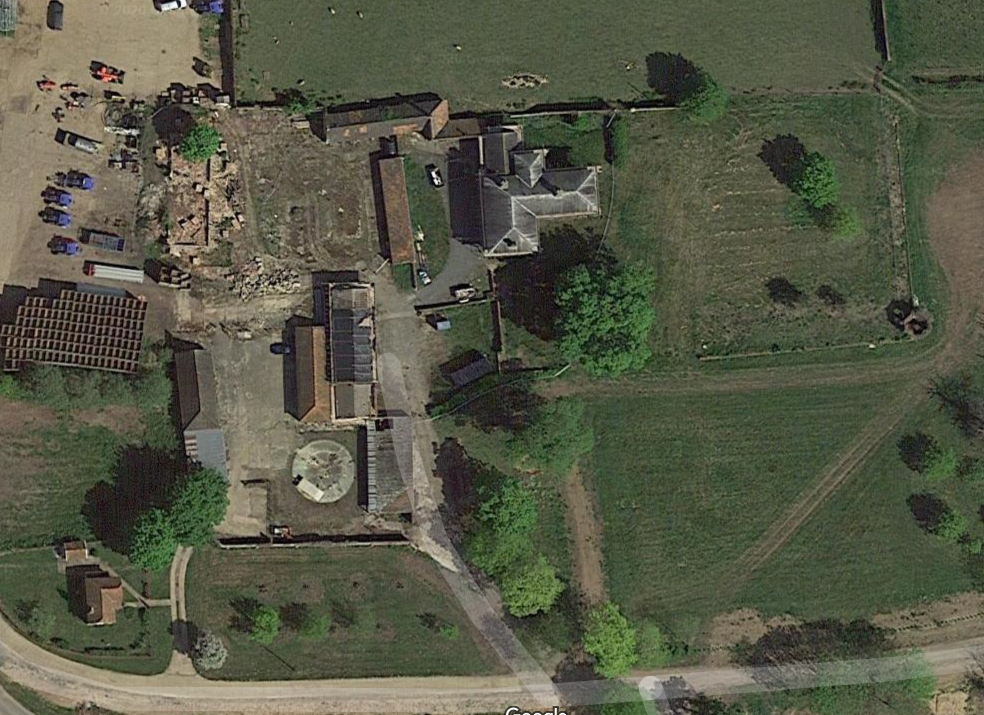
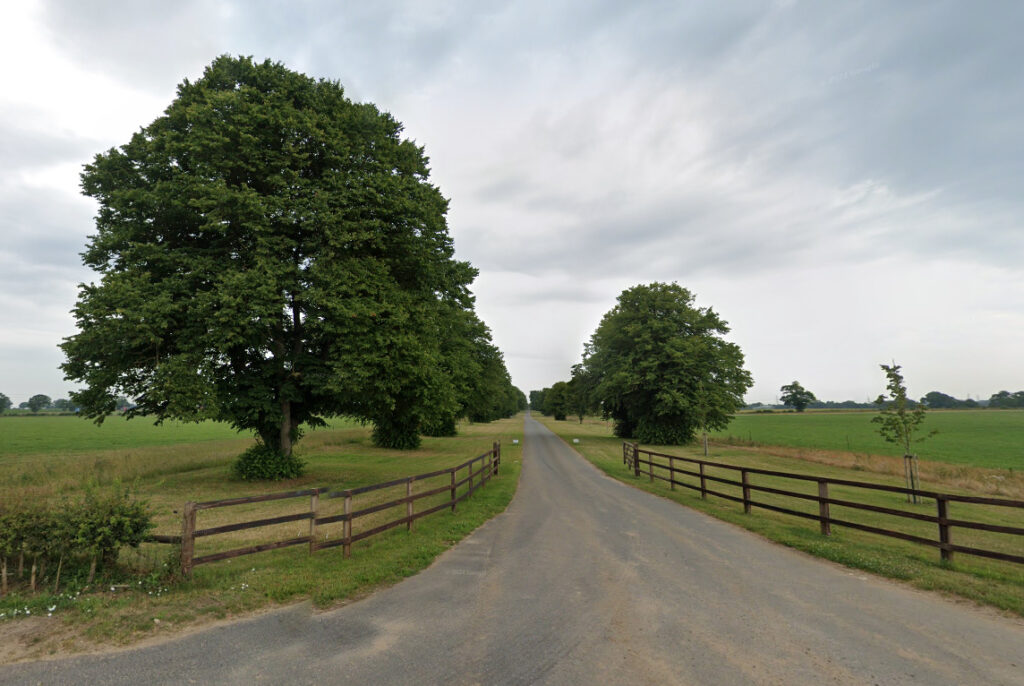
Although most of the early pleasure gardens have long since gone, to the east of the house sections of wall from the seventeenth-century walled garden, depicted on the undated drawing showing the house of Sir Henry Johnson, and octagonal summerhouse in the south-east corner survive. Also surviving is an eighteenth-century gateway with ornate wrought iron gates (Grade II) on the central axis of the entrance drive that was once centred on the house.
In 2025 the landscape setting of Frison Hall and views are threatened by the cumulative effects of proposed energy and infrastructure projects such as Sizewell C, Sealink and Lionlink and pipelines. A substation and new pylons are proposed on land to the north-east for Sizewell C and potential expansion of the substation to accommodate power from large convertor stations slightly further north. The scale of the projects means severe disruption during the construction periods and immense visual impact on the setting of the Hall once the tall structures have been built.
SOURCES:
Barker, H. R., East Suffolk Illustrated, 1908.
Birch, Mel, Suffolk’s Ancient Sites Historic Places, 2004.
Page, Augustine, Topographical and Genealogical, The County of Suffolk, A Supplement to the Suffolk Traveller (of J. Kirby), compiled 1811 and published in 1844 by Page, Joshua.
Williamson, Tom, Sandlings: The Suffolk Coast and Heaths, 2005.
Suffolk Gardens Trust site visit to Blackheath House and conversation with the owner Michael Hopkins, May 2006.
History of Parliament, https://www.historyofparliamentonline.org/volume/1690-1715/member/johnson-sir-henry-1659-1719 (accessed November 2020).
http://www.architecturalhistory.co.uk/news/item/case_studies/friston-hall-suffolk (Accessed November 2020).
http://friston.onesuffolk.net/home/our-village/history/ (accessed June 2020).
Kirby’s 1736 map of Suffolk.
Bowen’s map of Suffolk, 1762.
Hodskinson’s Map of Suffolk in 1783.
1847 (surveyed 1839) tithe map and apportionment.
1884 (surveyed 1882) Ordnance Survey map.
1905 (revised 1903) OS map.
1928 (revised 1925) OS map.
2022 Google aerial map (Imagery © Bluesky, CNES / Airbus, Getmapping plc, Infoterra Lts & Bluesky, Maxar Technologies, Map data © 2022).
Heritage Assets:
Suffolk Historic Environment Record (SHER): FRS 048, FRS 080
Friston Hall (Grade II), Historic England No. 1215909.
Gate and Gate Piers 15 metres north east of Friston Hall (Grade II), Historic England No. 1287969.
Suffolk Archives (previously Suffolk Record Office)
(SA) HD11/475/Friston/145. Photograph of a drawing of Friston Hall in the Isaac Johnson Map Collection at Suffolk Archives.
Site ownership: Private
Study written: January 2023
Type of Study: Desktop
Written by: Tina Ranft
Amended: