Parish: BLUNDESTON
District: EAST SUFFOLK (Previously Waveney)
TM 519 970
Not open to the public
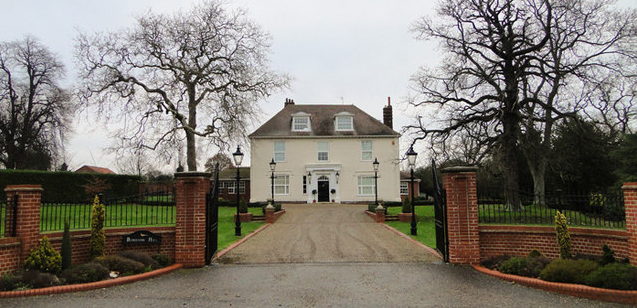
Blundeston Hall is c. 5km (3mls) north-west of Lowestoft, beside a stream that flows south-west into Blundeston Decoy, itself flowing into Flixton Decoy. Parts of the parish are well-drained, whilst the rest is seasonally waterlogged loam soils and silt over clay, the clay used in the mid- to late-eighteenth century to make Lowestoft Pottery.
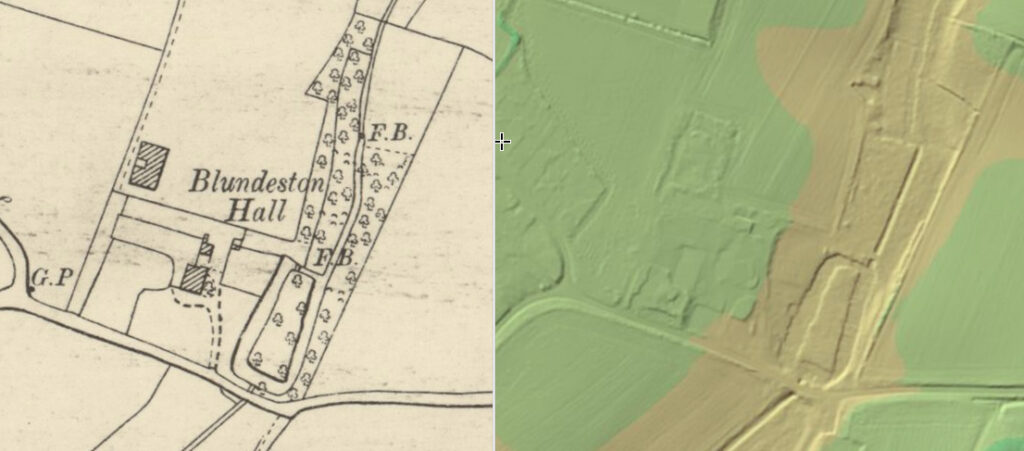
The site of the present Blundeston Hall nestles in a small valley with an ancient rectangular moat fed by the stream within the curtilage of the house and used as a feature in its gardens. Much altered and extended, including during the twentieth and early-twenty-first centuries, the house is not listed.
Once joined with Gunviles manor, the medieval manor of Blundeston Hall is documented from the early-thirteenth century when in the Lordship of the de Blundeston family. It had various owners during the following centuries. By the seventeenth century it was in the hands of the Allen family. The present Blundeston Hall is thought to be west of the site of the original manor house that was surrounded by a rectangular moat, today a scheduled monument.
By 1714 the house and manor were separated. The manor stayed in the Allen family and was eventually sold to Sir Samuel Morton Peto, Esq. of Somerleyton Hall in 1844. Blundeston Hall, farms, lands and duck decoy were bought in 1714 by Great Yarmouth merchant William Luson. The estate passed to William’s son Robert Luson on his marriage to Hephzibah Rix, who used it as their summer residence, no doubt to enjoy the wildfowling opportunities.
Robert’s will of May 1767 stipulates that his Blundeston Hall estate be divided between his daughters. His eldest Maria, who married George Nicholls, Esq., a cousin to the Revd Norton Nicholl of Blundeston Lodge, inherited Blundeston Hall. His second daughter Hephzibah inherited a house and land to the north-west, where she and her husband Nathanial Rix employed Sir John Soane to design a new house that is known today as Blundeston House. Elizabeth, his third daughter, inherited other land in Blundeston, Corton and Lound.
Some references have confused the three major houses of the village during the late-eighteenth and nineteenth centuries. They were Blundeston Hall, Blundeston House and Blundeston Lodge, the latter being the home of the Revd Norton Nicholls, friend of the landscape designer Humhry Repton. During that period Blundeston House and Blundeston Lodge changed names on numerous occasions. Some references at the end of the eighteenth century have called Blundeston Hall the home of the Revd Norton Nicholls, although he lived at the property that became known as Blundeston Lodge. Reference has also been made to the Hall being part of the Somerleyton Estate that was sold to Sir Samuel Morton Peto in 1844, whereas it was in the ownership of the Woods family at this time and refers only to the manor.
By 1826 Blundeston Hall was owned by Thomas Woods. In 1848, whilst staying with Sir Samuel Peto at nearby Somerleyton Hall, Charles Dickens visited the village, inspiring him to use the name in a changed form in his novel David Copperfield. Said to have presented a ‘weird and gloomy appearance,’ the Hall is believed to be a strong candidate as the fictional birthplace of David Copperfield.
Blundeston Hall appears to have stayed in the Woods family, although often leased out, until 1917 when Thomas Hardwick Woods put the estate up for sale in seventeen lots. The house, stables, outbuildings and c. 2.4ha (6a), were leased to Maj. Worship at the time of the sale. This was not long before the house is thought to have been extensively restored and lost its ‘gloomy appearance’. Hall Farm was a separate lot. Part of the land was sold as residential plots, 17ha (42a) was occupied by the military, with Cockshoot Covert, arable, pasture, osier land and marshes making up the rest. Soon after Blundeston Hall became the home of the Arnold family.
Once more for sale in 1934, it appears to have been bought by Nigel Somers Lewis and on his death in 1945 it was again for sale.
Minor alterations to the gardens attached to the house during the nineteenth and twentieth centuries saw footbridges across the moat added from the north and west, presumably to incorporate it into the gardens of the house. The moat still forms part of Blundeston Hall’s gardens and remains partly intact, although the inner island is overgrown with trees and shrubs.
A nineteenth century coach house/stable yard beside the road, near today’s entrance gates, has gone allowing an open central drive up to the south-facing entrance front. The grounds attached to Blundeston Hall have been reduced with the building of a bungalow south-west of the house in the twentieth century. The rest of the grounds are laid to lawn, dotted with trees to the east with an enclosed private garden to the west.
SOURCES:
Copinger, W. A., The Manors of Suffolk, Vol. 5, 1909.
Cromwell, Thomas Kitson, Excursions in the County of Suffolk, 1819.
Druery, John Henry, Historical and Topographical Notes on Great Yarmouth and its environs, 1826.
Kitton , Frederick George, The Dickens Country, 1911.
Macdonald, Peppy, ‘Rural Settlement Change in East Suffolk, 1850–1939’, Degree of Doctor of Philosophy, August 2017. [unpublished document].
Page, Augustus, Supplement to the Suffolk Traveller [of J. Kirby] or Topographical and Genealogical Collections, Concerning That County, 1844.
Suckling, Alfred Indigo, The History and Antiquities of the County of Suffolk, Vol. I, 1846.
Turner, Dawson, Sepulchral reminiscences of a market town as afforded by a list of the interments within … the Parish Church of St Nicholas, Great Yarmouth …, 1848.
Ward, Robert, Wealth and Notoriety; the extraordinary families of William Levy and Charles Lewis, 2013.
Parish information, https://heritage.suffolk.gov.uk/media/pdfs/blundeston.pdf (accessed February 2022).
NB: Blundeston House was formerly High House and The Lawns. Blundeston Lodge was formerly Sydors and Blundeston Villa.
Maps:
1837 (surveyed 1841) tithe map and apportionment.
1884 (surveyed 1882 to 1883) OS map.
1906 (revised 1904) OS map.
1929 (revised 1926) OS map.
Heritage Assets:
Suffolk Historic Environment Record (SHER): BLN 001.
Historic England Scheduled Monument No. 1018966. Moated site at Blundeston Hall.
Suffolk Archives (previously Suffolk Records Office):
(SA) B/150/1/2.16. Copies of Enclosure Map for Blundeston, 1805.
(SA) 1117/48/6. Sales Particulars for the Blundeston Hall Estate, 15 February 1917.
(SA) 1117/48/1. Sales Particulars for the Blundeston Hall, 7 July 1934.
Site ownership: Private
Study Written: February 2026
Type of Study: Desktop
Written by: Tina Ranft
Amended: