Parish: CAVENDISH
District: WEST SUFFOLK
TL 794 459
Not open to the general public except for booked stays
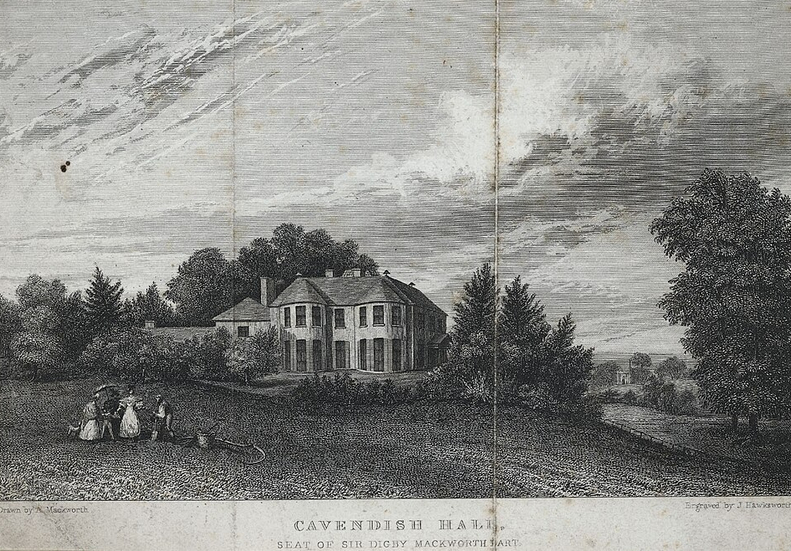
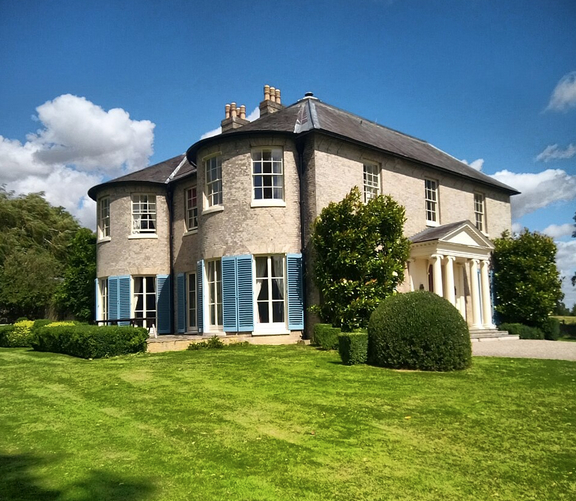
Early-nineteenth century Cavendish Hall (Grade II) is in an isolated position west of Cavendish village, c. 11km (7mls) north-west of Sudbury and 16km (10mls) east of Haverhill. On the headland between the River Stour to the south and one of its tributaries to the east, it lies on a sloping site in the rolling landscape of the valley side.
OWNERS OF CAVENDISH HALL
During the sixteenth century the land occupied by Cavendish Hall was part of the Manor of Overhall Cavendyshe. Over the following two centuries it passed through numerous hands until it was sold to the lawyer Thomas Ruggles in 1791. It was subsequently sold to Thomas Halifax, a London Banker, who built a new house on the site c. 1802 for one of his sons.
The Regency house and its small park were bought by Capt. Ogden c. 1814, but he died the same year when a sale of the contents of Cavendish Hall took place. The house and park was the home of Col. Gilbert Affleck who died in 1831. It is unclear whether he was the owner or a tenant. Sir Digby Mackworth Bt. (1766–1838) was resident during the 1830s, and once more it is not known whether he owned Cavendish Hall, although he has been suggested as a likely candidate for changes and additions to the house.
Having bought Cavendish Hall in July 1840, Dr John Yelloly (1774–1842) and his family moved there from Woodton Hall in Norfolk, having retired a wealthy man in 1831 from the post of physician at the Norfolk and Norwich Hospital where he had been since 1820. White’s Directory of Suffolk 1844 states that he had been physician to George IV before moving to Norfolk from London for the sake of his children’s health in 1814, although other sources state he was at the London hospital until 1818. He was a co-founder of the Royal Medical and Chirurgical Society in 1805, became a Fellow of the Royal Society of Medicine and was author of important medical papers. Having suffered a serious injury from a fall from his carriage in Norfolk in 1840, John never fully recovered and died the same year in Suffolk with his body returned to Woodton for burial.
His widow Sarah, daughter of Samuel Tyssen of Narsborough Hall in Norfolk, and their daughter stayed at Cavendish. Sarah died in 1854, when she too returned to Woodton for burial, while their daughter was still there in 1864. The Yelloly family continued to own the property and after being unoccupied in 1875, its numerous tenants included Lt. Col. Cecil Robert St John, JP, an American William Hume Trapman, James Gordon Stewart, the Revd Sir William Hyde Parker in 1892 and Mrs Adeline Ramsay L’Amy between 1896 and 1914.
During the 1920s Leslie Loxley Firth moved to Cavendish Hall with his family, including daughter Pamela. Leslie was a renowned horseman and heavily involved in the Jockey Club and York and Newmarket racecourses. Little is known about Cavendish Hall during the 1930s and World War II, although its later tenant, Mrs Morwenna Brocklebank, went on to buy Cavendish Hall from the Yelloly family in 1948.
In 1969 Morwenna sold Cavendish Hall to Tom Matthews, a wealthy American journalist and writer, who bought it for his wife Pamela, the daughter of Leslie Loxley Firth, who had many happy childhood memories of the Hall. However, Morwenna retained the ‘Coach House down the drive’ in which she lived until her death. In 1978 the Matthews were able to bring the coach house back into the estate when they bought it from Morwenna’s partner, Amos Staton.
In 1991 Tom Matthews died and Pamela followed in 2005 when the Pamela Matthews Trust was set up to manage the estate. It offered the lease of house and parkland to the Landmark Trust so that it could be ‘restored and then enjoyed by members of the public who wish to stay there’. Thus today it is available to rent through the trust.
CAVENDISH HALL
Refurbishments undertaken by the Landmark Trust c. 2010 revealed evidence suggesting there was an earlier house on the site. It was approximately in the north-east corner of the northern service wing and was incorporated into Thomas Halifax’s new c. 1802 country house.
It is believed that some additions were made soon after Thomas’s new house was originally built including the south-facing entrance front portico and double-storey bays on the west-facing garden elevation. This created a house that was later described as ‘an elegant modern mansion’. In 1901 the house had a conservatory on the south-west corner, which was later demolished to be replaced with a pergola by the Matthews.
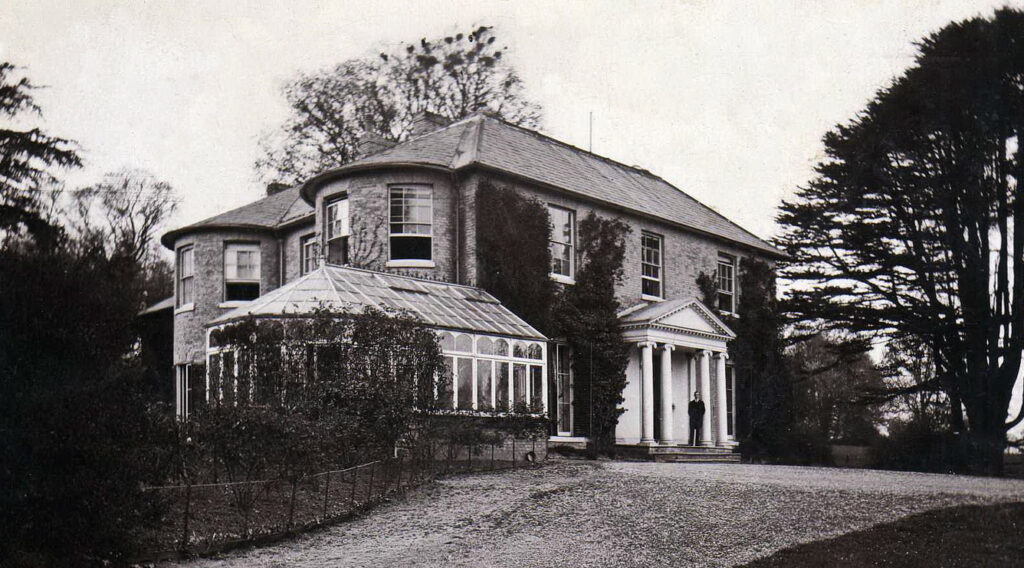
After it was leased to the Landmark Trust the refurbishment programme included new en-suite facilities, the reinstatement of the ground floor plan and decorating to its original style.
CAVENDISH HALL PARK AND GARDENS
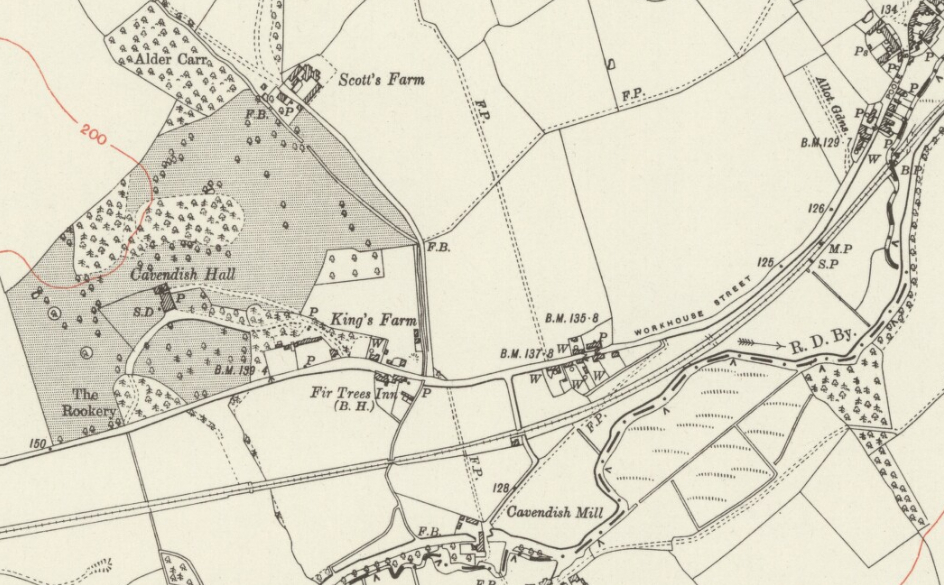
In 1844 White’s Directory described Cavendish Hall park as covering 20.2 ha (50a). Two years later the tithe map shows it as bounded to the south by the road from Cavendish to Clare and a track beside the tributary river along the eastern boundary leading to Scott’s Farm, which formed part of the Cavendish Hall Estate with fields to the east. Land beyond the parkland to the west and north were part of the Houghton Hall Estate and owned by Thomas George Heigham.
In 1846 the main entrance was from the south-east and an in-and-out drive led to the south-facing entrance front of the house and then returned to the road slightly further west where the entrance was flanked by a copse of trees. The south-east drive was partly flanked by an avenue of trees with a field and orchard to the east. A surviving walled garden divided in two by a central wall and bordering the road lay to the west of the drive with a small entrance lodge attached to its south-east corner. Approximately half way along this drive it divided to create a secondary drive that led to the stables at the rear of the house.
Standing approximately in the middle of its parkland, there were two small clumps of trees to the west in full view of the house across the gardens and parkland. To the north there was a larger oval-shaped area of woodland and another to its west. Forming part of the pleasure grounds, the oval-shaped wood had a circular path and cross paths that continued into the second woodland. A further wood beside the small river, today known as ‘Alder Carr’, stood outside of the northern boundary. The tithe map shows no formal gardens around the house.
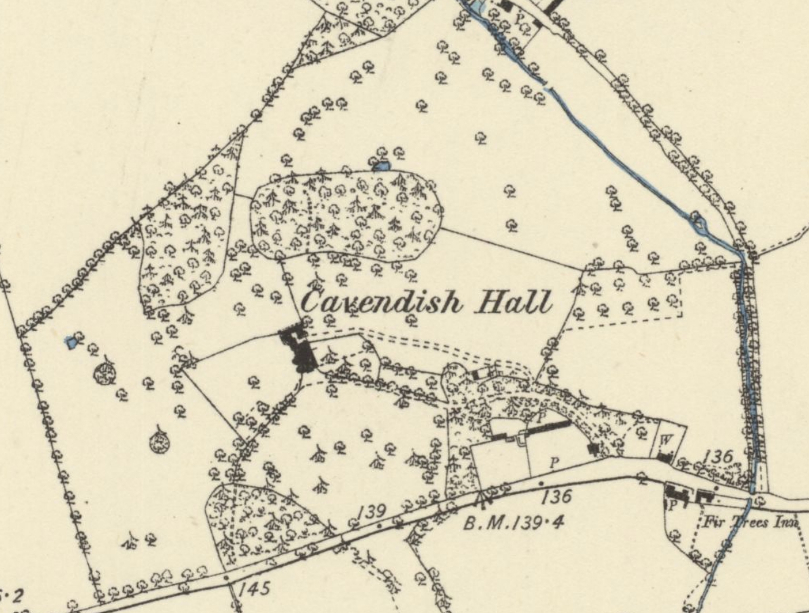
Except for the loss of the south-east section of parkland by 1925, little changed in the park from its early-nineteenth century creation until it was bought by the Matthews, who expanded the pleasure gardens into the parkland to the north of the house. They created gardens that were said to be ‘a riot of well-established flowerbeds in the English country style’ to detailed planting schemes drawn up by a friend in 1970.
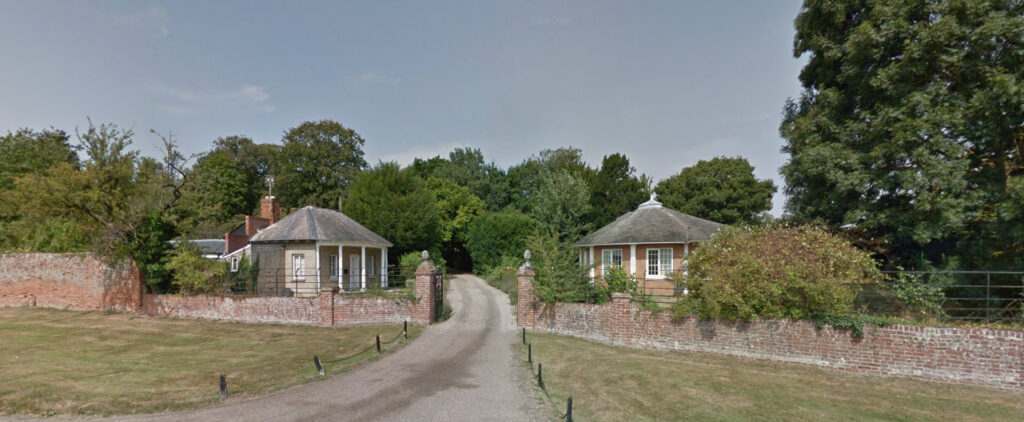
A conservatory attached to the house was replaced by a pergola and in 1992 a new kitchen garden was designed by the architect Neil MacFadyen of Carden & Godfrey and established close to the house to the north-east. A further surviving entrance lodge to the right-hand side of the main entrance was built sometime after 1925. Around the same time the western drive was lost, although its course is still marked by some trees that are the remains of the nineteenth century avenue lining the drive.
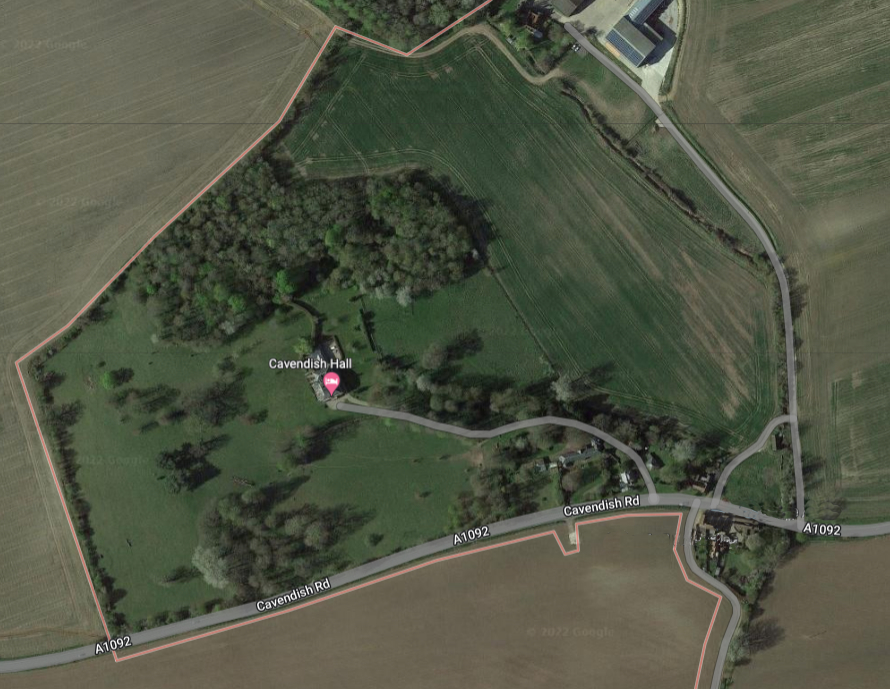
Today the unbroken continuity of the early-nineteenth century parkland is still visible giving views from the house across the parkland and countryside. This includes a number of veteran oaks, limes and exotic trees, although a number were lost in the 1987 hurricane including the Cedar of Lebanon that is shown as a young tree in the c. 1820 engraving by J. Hawksworth.
Since taking on the lease, the Landmark Trust has embarked on a programme of tree planting but could not afford the maintenance of the elaborate pleasure garden planting left by the Matthews. Instead the landscaping has been simplified to ‘evoke how it might have been in the early-nineteenth century’ when the house was first built. This includes trees along the drive and within the pleasure grounds underplanted with flowering shrubs. The park now extends to c. 12ha (30a), a reduction of c. 8ha (20a) from its 1844 extent and mainly as a result of the loss of the eastern section of parkland. The south-eastern lodges, coach house and walled garden are all within the bounds of the parkland.
SOURCES:
Copinger, Walter, Arthur, The Manors of Suffolk: Vol. I, The Hundreds of Babergh and Blackbourn, 1905.
Kelly’s Directory of Cambridge, Norfolk and Suffolk 1892.
Moore, Norman, Dictionary of National Biography, 1885–1900, Vol. 63, https://en.wikisource.org/wiki/Dictionary_of_National_Biography,_1885-1900/Yelloly,_John (accessed August 2022).
Register 1939.
Parish Transcript Burial. Burial Record for John Yelloly, 8 February 1842.
Suffolk Traveller (of J. Kirby), compiled 1811 and published in 1844 by Page, Joshua.
Stanford, Caroline, Cavendish Hall History Album for the Landmark Trust, April 2010. https://www.landmarktrust.org.uk/globalassets/3.-images-and-documents-to-keep/history-albums/cavendish-hall-history-album.pdf
The Peerage, Baronetage and Knightage of the British Empire Part 2.djvu/39, 1881.
White, William, History, Gazetteer & Directory of Suffolk, 1844, 1855.
Sales Catalogue, Thursday, November 17, 1814. Information from the Landmark Trust History Album. https://www.landmarktrust.org.uk/globalassets/3.-images-and-documents-to-keep/history-albums/cavendish-hall-history-album.pdf (accessed May 2025)
https://www.gravestonephotos.com/public/gravedetails.php?grave=246497 (accessed August 2022).
Cavendish Hall History Sheet, the Landmark Trust, April 2010. https://www.landmarktrust.org.uk/globalassets/3.-images-and-documents-to-keep/history-albums/cavendish-hall-history-album.pdf
Census: 1841, 1851, 1861, 1871, 1881, 1891, 1901, 1911.
Maps:
1846 tithe map and apportionment.
1885 (surveyed 1885) OS map.
1925 (revised 1920) OS map.
Heritage Assets:
Cavendish Hall (Grade II). Historic England No: 1031763.
Suffolk Archives (previously Suffolk Record Office):
(SA) HD526/27/5. Report of a sale of furniture at Cavendish Hall, 11 September 1915.
National Archives Kew:
PROB 11/1561/194. Will and probate of William Lambert Odgen, 12 October 1814.
PROB 11/1785. Will dated 12 August 1821 and probate 19 May 1831 of Gilbert Affleck.
PROB 11/1895/299. Will and probate of Sir Digby Mackworth, 23 May 1838.
PROB 11/2203/139. Will of Sarah Yelloy, 20 December 1854.
Site ownership: Private
Study written: June 2026
Type of Study: Desktop
Written by: Tina Ranft
Amended: